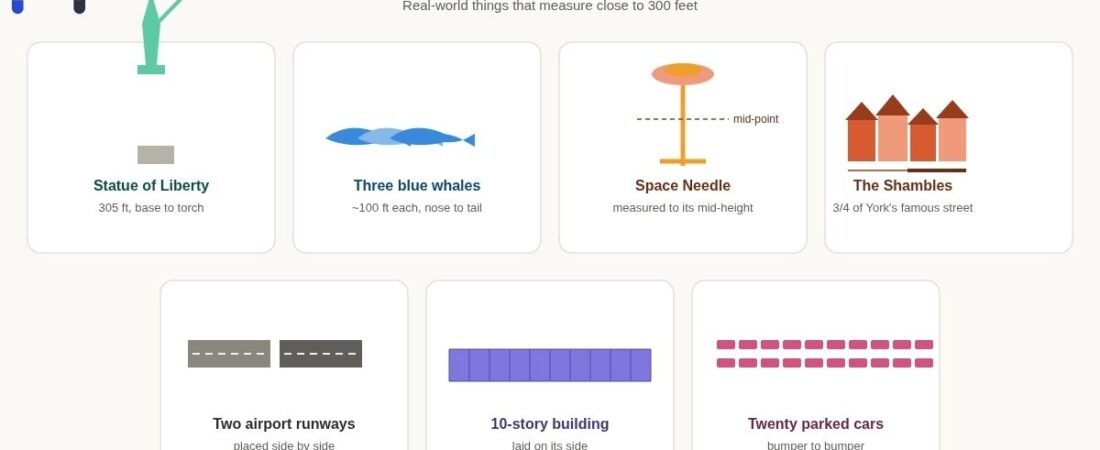
How Far Is 300 Feet? It’s roughly the length of a football field without the end zones. That’s much farther than most people guess. Until you compare it with something familiar, 300 feet is just another number. Once you see it in everyday terms, though, it’s much easier to picture and remember.
People usually search for how far is 300 feet visually because they need a quick mental reference. Maybe you’re estimating the size of a property, checking a safe distance, planning an outdoor project, or simply curious. Whatever the reason, knowing what 300 feet long looks like in real life helps you make faster, more confident judgments without reaching for a measuring tape.
You’ll soon discover 12 everyday examples that make this distance easy to imagine. From well-known landmarks to common objects, each comparison is designed to answer the question in a practical way. And if you’d like another helpful size comparison, don’t miss our guide on 50 feet long, which makes it even easier to visualize shorter distances.
How Far Is 300 Feet?
300 feet is a distance equal to 100 yards or 91.44 meters. It is longer than many people expect when they first hear the number. Knowing this measurement makes it easier to understand and estimate distances in everyday situations.
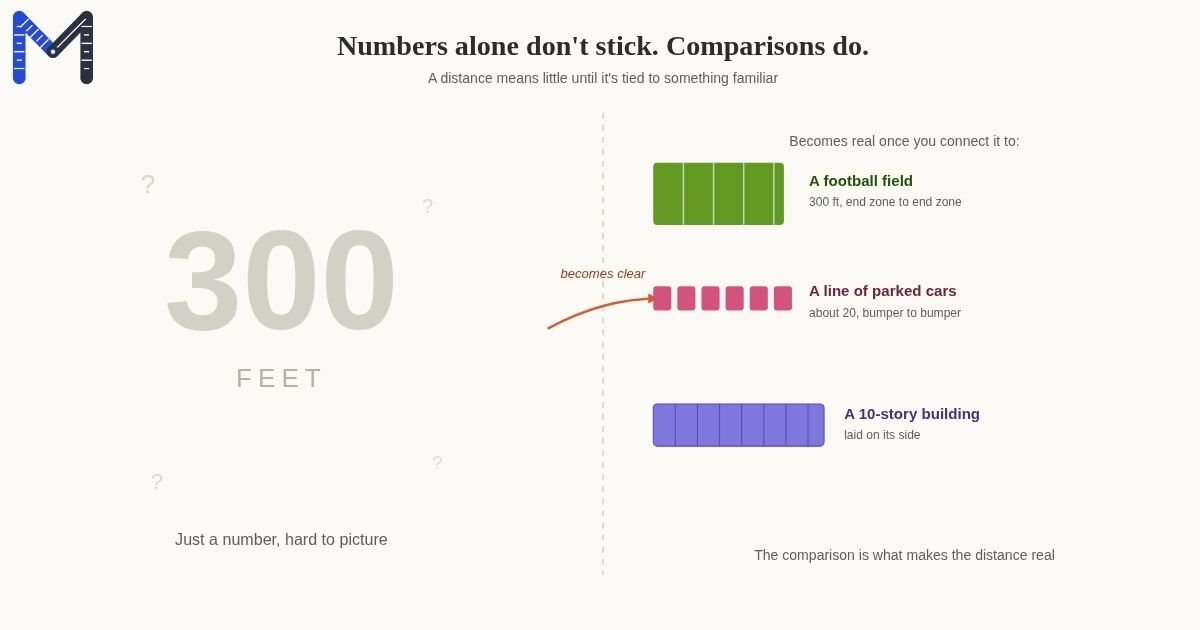
Our brains aren’t wired to “see” measurements from numbers alone. A distance like 300 feet becomes meaningful only when it’s connected to something familiar, such as a football field, a line of parked cars, or a building. That’s why real-life comparisons create a clear mental picture that numbers by themselves rarely can.
(12 Real-Life Examples Surprise You)
12 Everyday Comparisons That Reveal How Far 300 Feet Really Is
Statue of Liberty
The Statue of Liberty is a useful comparison for understanding large measurements because it stands about 305 feet (93 meters) tall from the ground to the tip of the torch. Its height is close to the scale of 300 feet, making it easier to imagine the size of a large structure.
Located on Liberty Island in New York Harbor, this historic landmark combines engineering, architecture, and history. Many people are surprised that the statue itself is only part of the monument, with the pedestal adding significant height to the overall structure.
Using the Statue of Liberty as a size reference helps turn a number into a visual image. Instead of imagining hundreds of feet from measurements alone, people can picture a famous landmark they already recognize.
Three Blue Whales
Three blue whales lined up end to end create a surprising natural comparison for a distance of around 300 feet. A large blue whale can reach about 80 to 100 feet long, so three together can approach this impressive length.
Blue whales are the largest animals ever known to exist and can weigh over 100 tons. Their enormous bodies provide a unique nature-based example of scale compared with buildings, vehicles, and other structures.
This comparison helps readers understand how big 300 feet really is by using a familiar living creature. Visualizing multiple giant whales together makes a large measurement easier to picture without tools.
Boeing 747 Airplane
A Boeing 747 is a helpful transportation example for understanding a measurement close to 300 feet. Depending on the model, the aircraft is around 230 to 250 feet long, giving readers a strong sense of a very large distance.
Known as the “Jumbo Jet,” the Boeing 747 transformed air travel with its massive size and passenger capacity. Seeing one at an airport reveals how much space large transportation systems require.
Comparing 300 feet with a Boeing 747 helps people visualize length through a real-world object. It connects a simple measurement with something many people have seen at airports or in photos.
Space Needle (Mid-Height)
The Space Needle in Seattle reaches 605 feet (184 meters) tall, but its middle section provides a helpful way to imagine a measurement of around 300 feet. Half of this famous structure is close to the distance many people find difficult to visualize.
Built for the 1962 World’s Fair, the Space Needle became an iconic example of modern architecture. Its tall, narrow design shows how vertical measurements can create impressive city landmarks and change an urban skyline.
Using the Space Needle as a comparison helps readers understand large heights through a recognizable landmark. It makes measurements easier to picture by connecting numbers with real buildings people know.
The Shambles (3/4 Length)
The Shambles in York, England, is a historic street that offers a unique architectural comparison for understanding a long distance. Three-quarters of its length is roughly in the range of 300 feet, helping readers imagine this measurement as a walkable urban space.
This medieval street is famous for its narrow lanes, timber-framed buildings, and historic character. Many visitors are surprised that some parts of the street have remained largely unchanged for hundreds of years.
Comparing 300 feet with a famous street helps people understand distance in an everyday environment. It shows that this measurement is not just a number but a space you can experience while walking through a city.
Two Airport Runways
Two airport runway sections can help visualize a large distance like 300 feet. A typical runway is thousands of feet long, so a 300-foot section represents only a small part of the total length used by aircraft during takeoff and landing.
Airports are designed around precise measurements, with runways, taxiways, and terminals requiring careful planning. Even a short section of runway can feel surprisingly large when viewed from ground level.
This comparison connects large measurements with transportation and urban design. Thinking about a runway helps people understand how distance works in real-world spaces without relying only on numbers.
Ten-Story Building Laid on Its Side
A typical ten-story building is often around 100 to 120 feet tall, so laying several buildings end to end would create a distance close to 300 feet. This comparison helps connect a familiar structure with a large measurement that is difficult to imagine.
Buildings vary in height depending on design and location, but many public and residential buildings use similar floor-to-floor dimensions. Visualizing a tall building turned horizontally creates a simple way to understand architectural scale and length.
This comparison helps readers imagine 300 feet as a real space rather than just a number. It connects building dimensions with everyday surroundings and makes large measurements easier to picture.
Blackpool Tower (3/5 Height)
Blackpool Tower in England stands about 518 feet (158 meters) tall, and around three-fifths of its height is close to 300 feet. This makes it an interesting landmark comparison for understanding a large vertical measurement.
Built in 1894, the tower was inspired by the Eiffel Tower and became a famous example of Victorian-era architecture. Its steel structure and historic design have made it one of Britain’s most recognizable landmarks.
Using Blackpool Tower as a reference helps people understand how large 300 feet really is. A famous structure provides a stronger mental picture than a measurement alone.
White Knight Tree
The White Knight tree, a type of giant eucalyptus found in Australia, can reach impressive heights that help visualize large measurements. Some mature examples grow close to 300 feet, making them a useful nature-based comparison.
These towering trees are part of Australia’s unique forest ecosystems and show how large natural structures can become over time. Their height demonstrates the incredible scale that exists beyond human-made buildings.
Comparing 300 feet with a giant tree helps readers connect measurement with nature. It creates a visual reference that makes large heights easier to understand without special tools.
American Football Field
An American football field is a familiar sports comparison for understanding 300 feet. The playing field is 100 yards long, which equals 300 feet when measured from one end zone to the other.
Football fields are common reference points because many people have seen their size in stadiums or on television. The markings, sidelines, and goal areas make the distance easy to visualize.
Using a football field as a size reference helps turn a measurement into an everyday experience. It shows that 300 feet is roughly the length of one complete field.
Professional Soccer Field (Minimum Length)
A professional soccer field can also help explain a 300-foot distance. According to international standards, the minimum length for many professional matches is about 300 feet (90 meters), making it a close comparison.
Soccer fields vary in size depending on stadium design and competition rules. Their large open areas are carefully planned as part of sports architecture and urban design.
Comparing 300 feet with a soccer field helps people understand distance through a familiar sports environment. It provides a practical example of how large spaces are designed and used.
Twenty Parked Cars
Twenty parked cars lined up can create a surprisingly close comparison to a 300-foot distance. With an average car length of about 15 feet, twenty vehicles placed bumper to bumper would stretch roughly 300 feet.
Cars are one of the easiest objects to visualize because most people see them every day in streets, parking lots, and garages. A long row of vehicles quickly shows how much space this measurement covers.
This comparison makes 300 feet easier to imagine in an urban environment. It connects a large distance with something familiar and practical from daily life.
Redwood Tree Height
Redwood trees are among the tallest living organisms on Earth, with some reaching heights of over 300 feet. These giant trees provide one of the best natural examples for understanding an enormous vertical measurement.
Found mainly along the coast of California, redwoods can grow for hundreds of years and create forests with towering canopies. Their height often surprises visitors who stand beneath them.
Using a redwood tree as a size reference helps people visualize extreme scale in nature. It shows that 300 feet is not just a number but a height that exists in the real world.
Conclusion
Large measurements are easier to understand when we compare them with real-life examples. Seeing how 300 feet long relates to buildings, fields, vehicles, and nature helps answer questions like how far is 300 feet visually and creates a clearer mental picture.
The best way to understand distance is to connect numbers with familiar experiences. Once a measurement becomes something you can imagine, it becomes much easier to remember and use in everyday life.